Title: Illuminating the Surgical Field: Why Fiber Optics Are Non-Negotiable in Oral Surgery
In the realm of oral surgery, precision is predicated on visibility. The ability to differentiate between hard and soft tissue, identify critical anatomical structures, and perform osteotomies with accuracy requires an unobstructed, shadow-free view of the operative site. While standard illumination has evolved from bulky overhead lamps to integrated handpiece lighting, the debate between self-contained LED generators and fiber optic transmission remains critical. For the oral surgeon, fiber optic illumination is not merely an upgrade; it is the clinical standard for ensuring safety and efficacy.
The Stability Advantage: Air Turbines and the 6-Hole Connection
The most common configuration in surgical suites involves the high-speed air turbine connected via a 6-hole tubing. While 4-hole connections are standard, the 6-hole connection is specifically designed to accommodate the fiber optic light source. The clinical advantage here is stability. Standard LED generator handpieces rely on the turbine’s rotation to power an internal light bulb. In a surgical context—specifically during bone reduction or sectioning of impacted teeth—bur resistance causes the turbine to slow down. This drop in RPM results in a corresponding drop in voltage to the internal LED, causing the light to dim precisely when the surgeon needs maximum visibility to see the depth of the osteotomy.
Conversely, a fiber optic handpiece connected to a 6-hole system draws power from a stable, external light source in the control box. The light intensity remains constant regardless of the handpiece’s load or RPM. Whether the bur is cutting through dense cortical bone or idling, the illumination remains brilliant and consistent, eliminating the “strobe effect” that can cause eye strain during long procedures.
Versatility Across Handpiece Modalities
The benefits of fiber optics extend beyond the high-speed air turbine, proving essential in both straight handpieces and electric motor systems.
- Straight Handpieces: In procedures such as alveoloplasty or the removal of exostoses, the straight handpiece is the workhorse. Shadows cast by the patient’s lips or cheeks can obscure the surgical field. A fiber optic straight handpiece projects light directly onto the cutting surface, bypassing external shadows. This is vital for maintaining the correct angulation during bone smoothing.
- Electric Handpieces: Electric motors offer the distinct advantage of constant torque. When paired with fiber optic attachments (often via an LED coupling or integrated light motor), the combination is unparalleled. The motor maintains speed under load, while the fiber optic system ensures that the increased cutting power is matched by unwavering visibility. Unlike generator LEDs, which might flicker if the air pressure fluctuates, electric fiber optic systems deliver a steady, high-lumen output that mimics natural daylight.
Clinical Case: Impacted Mandibular Third Molar
*Patient Presentation:* A 32-year-old male presented with a deeply impacted mandibular third molar (mesio-angular) requiring surgical extraction.
*Procedure:* A mucoperiosteal flap was raised, revealing the tooth sitting deep within the alveolar bone. Due to the depth of the impaction, overhead lighting failed to penetrate the surgical crypt. Using a standard air turbine with an internal LED generator, the initial osteotomy was challenging; every time pressure was applied to remove buccal bone, the turbine loaded, and the light dimmed, leaving the surgeon navigating a dark, bloody field.
*Intervention:* Switching to a fiber optic high-speed handpiece (6-hole) transformed the procedure. The light source pierced the depth of the socket, clearly delineating the cementum of the tooth from the surrounding bone. Subsequently, a fiber optic straight handpiece was used for smoothing the sharp bone margins. The consistent, shadow-free illumination allowed for precise removal of the inter-radicular bone without risking damage to the lingual plate. The procedure concluded faster with reduced tissue trauma, directly attributed to the enhanced visualization.
Comparative Analysis
For the dental professional evaluating equipment, the technical differences highlight the clinical superiority of fiber optics.
| Feature | Fiber Optic Illumination | Internal LED Generator |
| Light Source | External light source (via coupler/motor). | Internal turbine-driven generator. |
| Intensity Stability | Constant. Unaffected by bur load or RPM. | Variable. Dims under load (stall torque). |
| Shadowing | Minimal; light projected coaxially at the tip. | Moderate; bulbs often offset from axis. |
| Maintenance | Requires external light source; fiber bundles can degrade over time. | Self-contained; no external cables needed but generator parts wear. |
| Oral Surgery Suitability | High. Critical for deep, narrow surgical sites. | Moderate. Suitable for superficial restorative dentistry. |
| Handpiece Compatibility | High-speed (6-hole), Straight, Electric attachments. | High-speed air turbines only. |
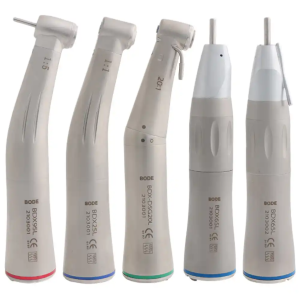
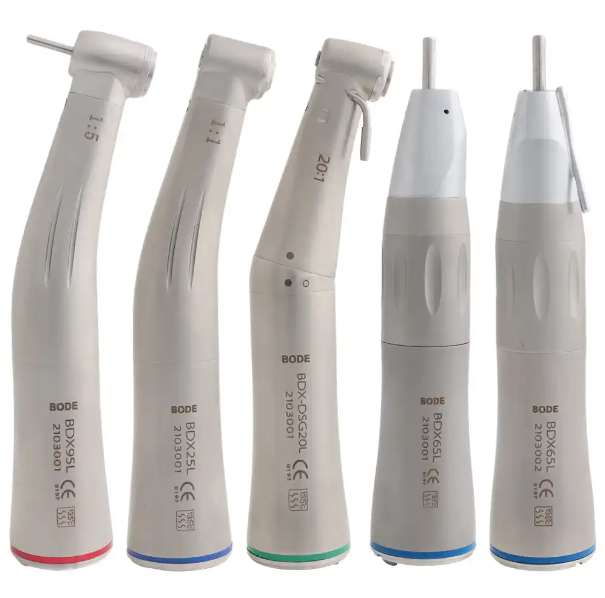
Whether you are seeking the high-torque efficiency of 1:5 and 1:4.2 increasing speed electric handpieces, the delicate control of 128:1 and 16:1 reduction ratios ideal for endodontics, or the balanced versatility of 1:1 contra angles and straight handpieces, Dentsma delivers. The collection of comprehensive portfolio extends to reliable high-speed air turbines, all available with your choice of advanced LED or fiber optic illumination. Whatever your clinical requirement, Dentsma provides all these essential solutions, ensuring you find the perfect fit for every procedure.
Close Thought: In oral surgery, where the margins for error are measured in millimeters, reliance on unstable lighting introduces unnecessary risk. Fiber optic technology, whether integrated into a high-speed 6-hole turbine, a straight handpiece, or an electric system, ensures that the surgical field remains illuminated regardless of mechanical load. By eliminating the variability of generator-based lighting, the surgeon gains a consistent visual anchor, leading to safer, more predictable surgical outcomes.